
Turn your iPhone into a pedometer for free.

Relax Melodies: A white noise ambience for sleep, meditation & yoga
By iLBSoft
Create your own melodies, set them to a timer, and relax.



Broths contain proline and glycine, which is a precursor amino acid for glutathione. Large amounts of glutathione are needed to help the liver get rid of chemicals.
Minerals such as calcium, silicon, sulphur, magnesium, phosphorous & trace minerals are in an easily assimilable form.
Grass-fed hormone and antibiotic free animal products are pricey, but buying bones especially if they are used multiple times to make large quantities of broth is cheap. It may also save you money by replacing expensive mineral or protein supplements.
When bone broth cools it forms gelatin, (like jello). Gelatin is basically the same as collagen. Collagen is when it is in the body, and when it’s extracted we call it gelatin. Many people take gelatin or collagen supplements to strengthen their hair and nails.
Many people drink bone broth with Leaky Gut Syndrome to help repair the lining of the gut. The glycine improves digestion by increasing gastric acid secretion, and glutamine, also found in bone broth, is important fuel for cells in the small intestine.
The tradition of having chicken soup when you are sick, has medical truth to it. The detox properties and minerals help your body get rid of the bad stuff, like colds, faster.
It is used in Chinese medicine to strengthen and nourish our essence or qi, and as well as warm the yang and build blood. A South American proverb says, “Good broth will resurrect the dead.” Even as early as the 12th century, Egyptian physician Moses Miamonides prescribed it for colds and asthma.
Bone both contains the broken down material from cartilage and tendons, such as chondroitin sulphates and glucosamine, now sold for arthritis and joint pain.
I’ve eaten a ton of bad tasting food in the name of health, but broths actually improve the taste of whatever you are cooking, or taste delicious as a beverage. I’ve even dissolved some curry powder in it, for a different flavor and for the anti-inflammatory benefits of turmeric.
I’ve let it simmer on the stove, but an even easier way is to put in a crockpot with some vinegar, salt, and I add a few cloves of garlic. Then just let it simmer for 24 to 48 hours. I love one pot wonders.
Sources:
http://www.jadeinstitute.com/jade/bone-broth-health-building.php
http://divinehealthfromtheinsideout.com/2012/05/bone-broth-nutritional-facts-benefits/
http://www.westonaprice.org/food-features/broth-is-beautiful
http://thewellspring.org/the-power-of-the-almighty-bone-broth/
http://www.wisechoicemarket.com/benefits-of-bone-broth/

I just finished reading this book, Explain Pain by David Butler M.App.SC and Dr Lorimer Moseley PhD, which I borrowed from my Physical Therapist. Although some of the concepts were complicated, I thought everything was explained in a way that a person with no medical background (myself) would be able to understand.
The best part of the book is how they scientifically explained the connection between the mind and body and how it directly influences your pain. I also liked how they didn’t commit to a recovery method, or preach a way to get better. Instead, they advocate to learn as much about pain and your condition to help you make informed decisions on your healing journey and to lessen your fear about pain that you can’t explain or understand. On a less positive note, I thought they could have addressed better some of the unlikely causes of pain, such as nutritional deficiency, bacteria, viruses, heavy metals, and other environmental toxins. They do mention that everyone’s pain is unique to them, which I found to be particularly helpful since most medical professionals will just diagnose what is familiar to them, and not necessarily see a patients unique situation & body.
Here are some quotes that I found to be particularly helpful:
“Because tissues are no longer the main issue, it is often not helpful to seek an understanding of the diagnostic label. It is better to seek an understanding of the particular symptoms which are a feature of your unique presentation”
‘For many people in persistent pain, this is a critical issue to understand and well worth repeating. In this sensitised state, the brain is being fed information that no longer reflects the true health and abilities of the tissues at the end of the neurones. Put another way, the brain is being told that there is more danger at the tissues than there actually is.”
“It is important to emphasise here that, when the brain is sensitised, it is not just the experience of pain that is persistently produced. It also leads to persistent changes in the sympathetic and parasympathetic nervous systems, endocrine, immune and motor systems”
“All sorts of fears can lead you into a cycle of pain and disability from which it can be difficult to break free. Some of the information that you receive from health professionals, friends, family and the media may contribute to fear…To face these fears, you need to be informed and understand as much as possible about your body. And you will need to be brave – this is the vehicle for the road to recovery”
At the end of book there is a Further Reading Section that recommends the following titles, which I plan on looking into for future reading.
1. Wall, P.D., Pain, the Science of Suffering. 1999,
London: Weidenfield & Nicholson
2. Melzack, R. and P.D. Wall, The Challenge of Pain.
2nd ed. 1996, London: Penguin
3. Nicholas, M., et al., Manage your Pain. 2000, Sydney: ABC Books
4. Martin, P., The Sickening Mind. 1997, London: Harper-Collins.
5. Sapolsky, R.M., Why zebras don’t get ulcers: an updated guide to stress, stress-related diseases, and coping. 1998, New York: W.H. Freeman and Co.
6. Shone, N., Coping Successfully with Pain. 1995, London: Sheldon Press.

I found these really great videos on detoxing metals from your body. This is great information for anyone who is interested in learning more ways to get the chemicals out, and the good stuff in.
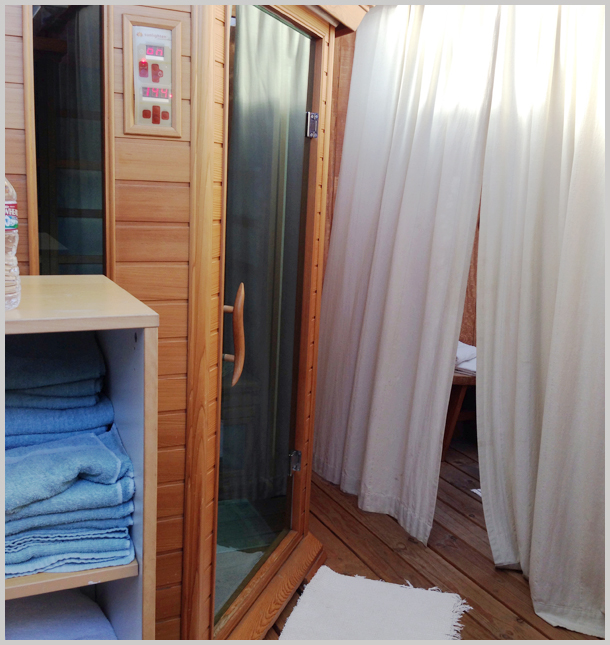
Last week, Tazmin and I tried out the infrared sauna at Tao Healing Arts Center. For $20 you get a 45 minute session in the sauna and 15 minutes to use the shower. You can also purchase package deals for a cheaper session. The sauna’s were in an area that was technically outside so you got a breeze, but were still under a roof. The facilities were clean, and the place was much more minimally decorated than an upscale spa, which I liked. It’s located in Santa Monica and parking is metered which is a downside, but the meters took credit cards so you don’t have to scramble for change. Plus, we weren’t rushed out when we decided to stay in ten minutes longer and skip our shower – we showered when we got home.
I went into the sauna in a lot of pain, and when I came out I definitely felt better. By the time the session ended, I was dripping sweat. The infrared sauna isn’t as hot as a traditional sauna, and the heat is able to penetrate deeper. I’ve been to a regular sauna and I could barely stand to sit in it, so I was really surprised at how comfortable this was.
This is also another great way to detox, which can only help me in the long run. Plus, if I’m experiencing detox symptoms again I might come back and see if it deceases them. Overall, I think this is a repeat experience. I was looking for a way to bring this to my apartment, and I found a Infrared Heat Lamp on amazon, that seemed promising. My acupuncturist used a heat lamp on me, and it really helped me feel better as well.
Furthermore, I’ve recently read the book Pain Free in Six Weeks by Sherry A. Rogers, M.D. and detoxing away pain from chemicals and heavy metals is something she goes into depth on, and her preferred method of detoxification is the infrared sauna.
